
PRINCIPLE ONE
The Discipline Behind Every Decision
A&D manufacturers have built information systems specifically designed to comply with long-standing ITAR, CMMC, and DFARS requirements. Those systems were not designed for the Intelligence Revolution. AI models accessing controlled data, agents acting on it autonomously, and derived content that may inherit the classification of its source material create compliance risks that traditional architectures never anticipated: Where does controlled data reside for an AI agent to access? Where does the data go when an agent decides to send it to an LLM? What is the security status of any derived content generated by the models?
How will you maintain audit integrity across autonomous workflows operating at machine speed?
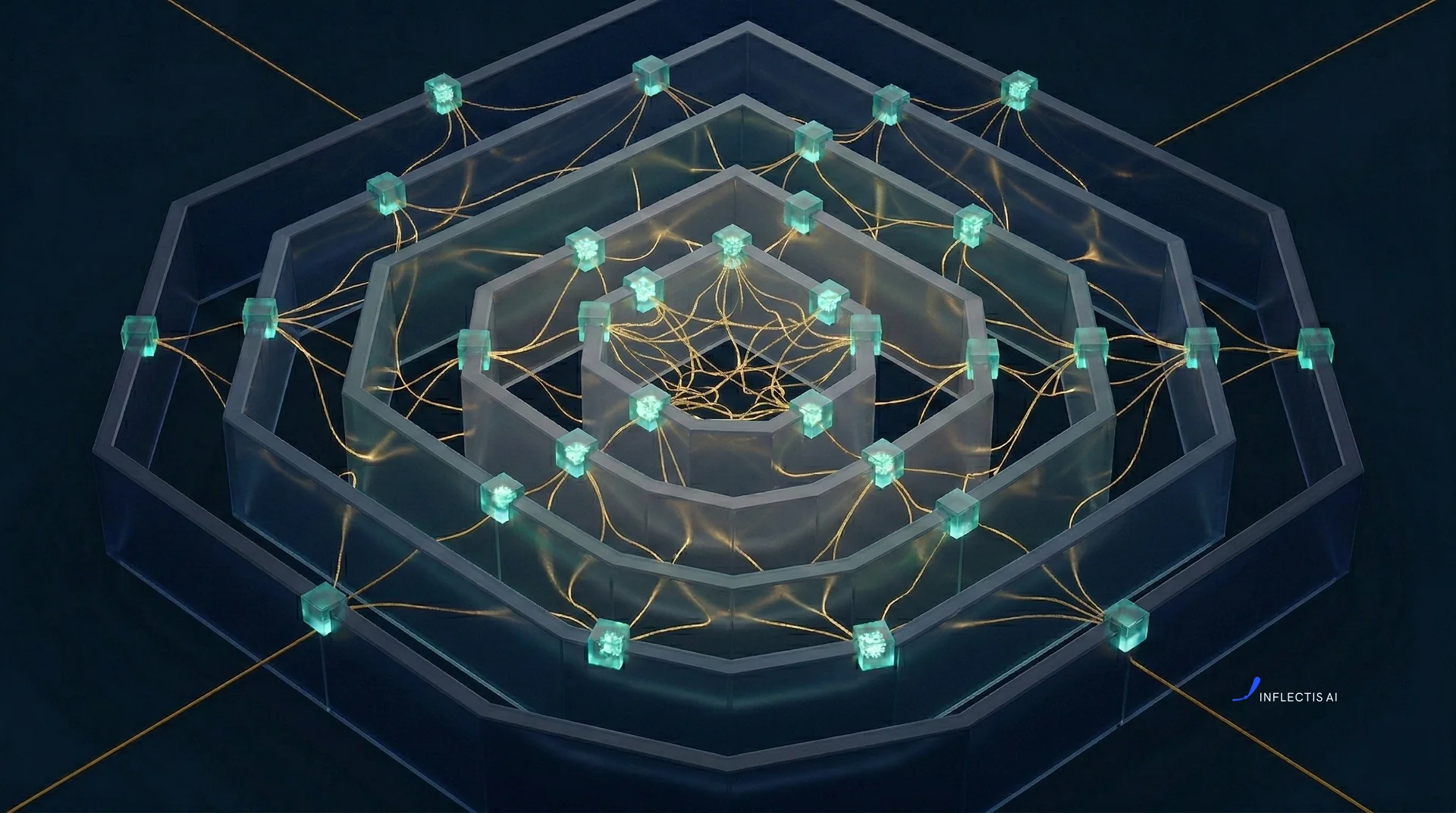
Inflectis AI works with your AI transformation team to embed compliance controls across the 5×5 framework, primarily at three critical technology layers. Infrastructure defines the security perimeter and data residency — on-prem or US-hosted, with no offshore processing. Data governs lineage tracking, access controls, and regulatory constraints that determine what can be processed, by whom, and under what conditions. Models must operate on CMMC-compliant cloud platforms or on-premises client-side hardware — ensuring that controlled data never breaches the compliance boundary during processing or transfer.
Data lineage is tracked from ingestion to manipulation and inference through to output. AI interactions with CUI and confidential information are bounded by structural controls. And every compliance-relevant act is written, as it happens, to an immutable record — the Ledger, the integrity core of Inflectis AI's VIGIL solution. A Ledger is not a log: it is complete, continuous, integrity-protected, and admissible. That distinction is what enables it to answer the question a log cannot — not only what your AI did, but what it did not do: whether controlled data ever breached a boundary it should not have, whether a model ever diverged from its certified baseline. Your AI platform doesn't just satisfy compliance requirements — it powers them, and stands prepared to prove it.
PROOF BY DESIGN
Built to Prove What Your AI Did — and Didn't do

EXPORT CONTROL
ITAR-Aware Architecture
Technical data handling, export control boundaries, and access controls designed into the platform architecture — not configured after deployment.
ASSESSMENT-READY
CMMC-Aligned Security Controls
AI infrastructure mapped to CMMC Level 2+ requirements, with documented control implementations and assessment-ready evidence.
REAL-TIME OVERSIGHT
Autonomous Compliance Monitoring
AI agents that monitor compliance in real-time — detecting anomalies, intercepting violations, and generating assessment-ready documentation without human intervention.
EVIDENCE ON DEMAND
Immutable Compliance Ledger
A continuous, query-ready record of every compliance-relevant act your AI performs — and of every non-compliant action intercepted and logged as a verified rejection.