
When the AI Sounds Certain, Do We Still Need to Check Its Work?

He saw it during a business trip to Singapore — on a wall along his walk from the ParkRoyal to Gardens by the Bay — a single row of characters, brushed in black, elegant enough to stop him mid-stride. He didn't know the language; in Singapore he'd hardly needed it, since everyone spoke English. He didn't know the neighborhood. He didn't know, and never thought to ask, what the sign was actually for. He only knew the shape of the thing was beautiful, and that he wanted it on his skin — a lifetime memory of a fantastic trip.

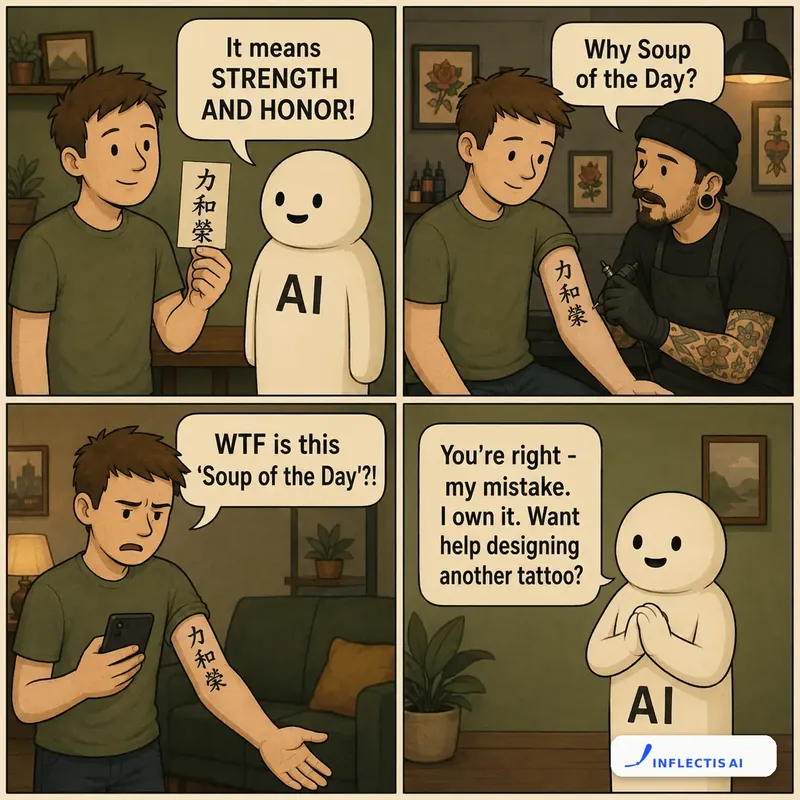
So Jim did what everyone does now. He raised his phone, framed the characters, and asked the AI what they meant.

The answer came back instantly, with the serene confidence of a machine that has read everything humans have ever written: "It means STRENGTH AND HONOR."

Wow, he thought. A perfect sign. Upon his return to the States, Jim carried the photo into a tattoo shop and had the row inked down the inside of his forearm — permanent, deliberate, done, before he'd even swung back by the office ahead of his next trip, to Qatar.

After nearly ninety minutes of painful, vibrating pinpricks, it was done.

Admiring her work as she runs his credit card, the artist glances at his arm, then into his eyes, with the polite curiosity of someone who has seen every reason a person walks in for ink. "Most of my customers have their reasons," she says. "Do you mind if I ask… why Soup of the Day?"

A look of perplexity crosses Jim's face as he pulls his phone from his pocket and shows her the original photo — the full frame this time. She flashes a wry smile. "That was a restaurant billboard," she tells him, "from the neighborhood I lived in before I moved to the States. Lovely little place." That row of characters Jim had found so striking was their daily special.

"I know," he tells her, pocketing his phone. "It was such a great place, I'll remember it for the rest of my life."

Then Jim slips out the back of the shop into the parking lot, fishes the phone from his pocket, and uploads the photo to the AI one more time. You told me this meant STRENGTH AND HONOR. It says Soup of the Day, he types.

"You're right," the AI replies, cheerful as ever. "My mistake. I own it. Would you like some help designing another tattoo?"

The machine had read virtually the entirety of human language — but it had failed to read the sign.
Frequently Asked Questions

Why does AI sound so confident when it is wrong?
Because a large language model is trained to produce fluent, plausible language — not to measure whether that language is true. Its tone is a property of the writing, not a signal of accuracy. The model generates the most statistically likely next words and delivers them in the same even, authoritative voice whether it is repeating something it has seen a million times or inventing something it has never seen at all. Confidence, in other words, is free; correctness is not. That gap is exactly why a fluent answer deserves the same scrutiny you would give a very self-assured stranger — pleasant, articulate, and entirely unverified. Takeaway: Treat an AI's confidence as writing style, not evidence — before you act on any assured-sounding answer, make the model show a source you can check, and set your trust by that source rather than the tone.
How do you stop AI hallucinations with grounding?
Grounding ties the model's answer to a specific, trusted source instead of its open-ended memory. In practice that usually means retrieval-augmented generation: before the model responds, the system pulls the relevant document, record, or reference and instructs the model to answer only from that material, with a citation. A grounded system can also say "I don't have a source for that" rather than filling the silence with an invention. Grounding does not make a model infallible, but it converts a confident guess into a checkable claim — one a person can trace back to the actual sign on the wall before anyone makes it permanent. Takeaway: For any task where a wrong answer is costly, put retrieval-augmented generation over a vetted source set in front of the model, require a citation in every response, and configure it to return "no source found" instead of guessing.
What is the difference between AI confidence and accuracy?
Accuracy is whether the answer matches reality. Confidence is how certain the answer sounds. In a language model the two are largely independent: the system can be fluent and emphatic while being completely wrong, and it carries no built-in awareness of the difference. Traditional software tends to fail loudly — it throws an error. A model fails quietly, in a calm and complete sentence. Treating the confident tone as evidence of accuracy is the core mistake, because the model was optimized to be convincing, not to be correct. The working rule follows from that: judge an AI answer by its verifiable sources, never by how sure it seems. Takeaway: Make "confidence is not accuracy" an explicit process/structural rule — score AI outputs on verifiable sources, add a visible verify-before-use gate for anything high-stakes, and never let a fluent tone shorten the review.
What controls keep a single AI mistake from becoming a permanent decision?
The safeguard is a verification step placed before any action that is expensive to reverse. High-stakes, one-way-door decisions — signing a contract, releasing a part, publishing a claim, inking a tattoo — should require a second, independent check of the AI's output against a primary source or a qualified person. Low-stakes, reversible decisions can move faster. The discipline is matching the amount of scrutiny to the cost of being wrong, so the moment where an unverified answer would turn irreversible always has a human-in-the-lead standing in its path. Most damage comes not from the model erring, but from acting on that error unchecked. Takeaway: Inventory your one-way-door decisions and require a mandatory second check — a primary source or a qualified human — in front of each one before an AI answer is allowed to trigger the action.
How should teams verify AI answers before acting on them?
Build the check into the workflow instead of relying on individual restraint. First, ask the model for its source and confirm the source actually says what the answer claims. Second, cross-check anything outside your own expertise with a person who has it — a translator, an engineer, an attorney. Third, widen the frame: the traveler saw one row of characters, not the whole billboard, and the missing context was the entire story. Finally, reserve the highest scrutiny for outputs that are permanent or public. None of this slows the routine work; it simply puts a deliberate pause exactly where a wrong answer would otherwise become a lasting one. Takeaway: Turn verification into a standard step, not a personal habit — require a cited source, route out-of-domain claims to a qualified expert, ask what context might be missing, and reserve the tightest review for anything permanent or public.